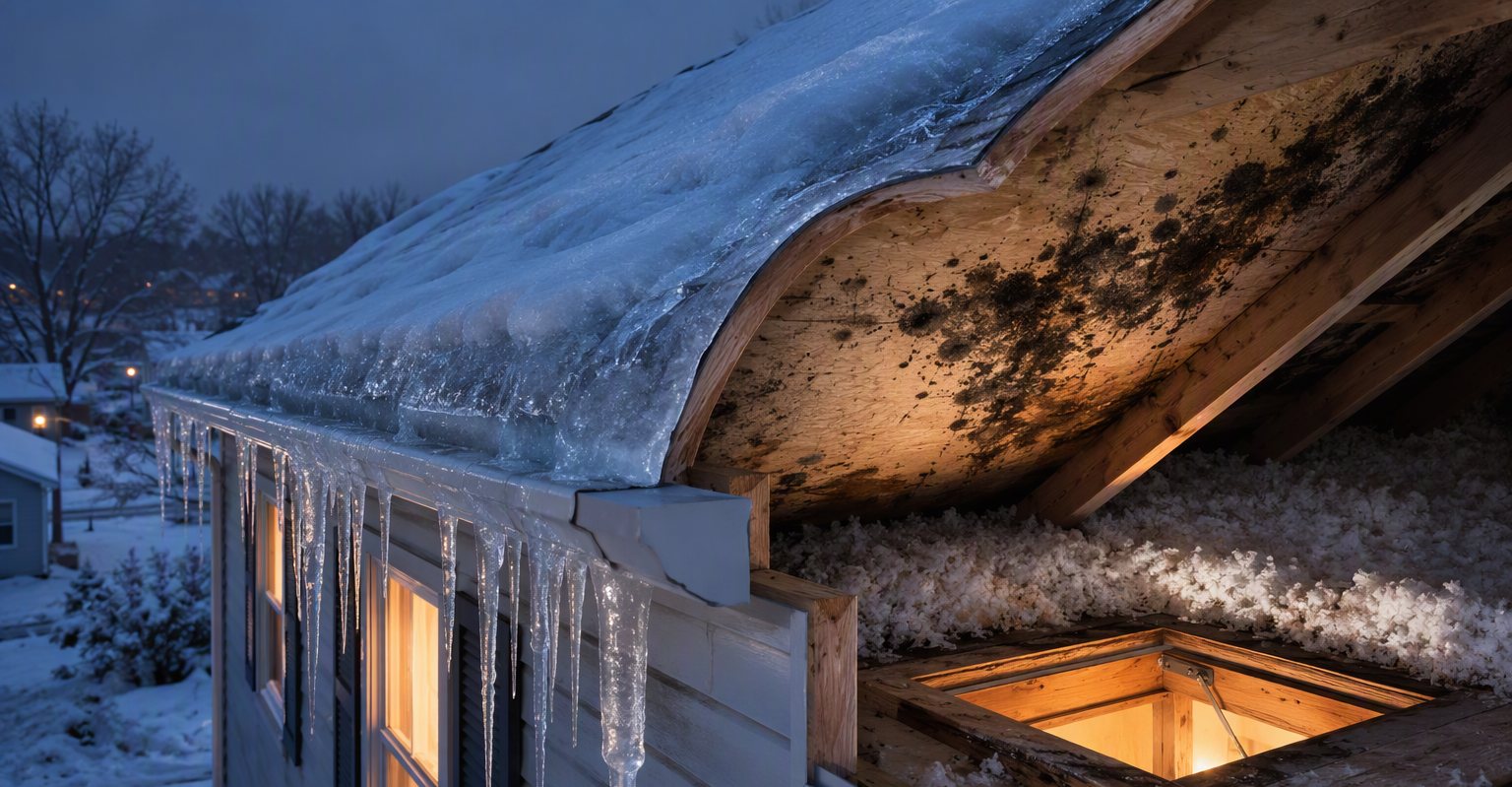
Attic mold feels like a summer problem, but in Ohio it’s mostly made in January. The roof deck sits at outdoor temperature; the house below pumps warm, moist air upward through every gap and recessed light. Where those meet, water appears — either as condensation fogging the cold sheathing every night, or as ice-dam meltwater wicking in from the eaves.
Reading the staining pattern
- Along the eaves and lower deck edges: classic ice-dam signature — meltwater backed under the shingles, wetting the deck edge and insulation a little more each thaw.
- Even coating on the north-facing deck: condensation. The north slope stays coldest, so it collects the most frost and grows the most mold.
- Hot spots around penetrations: a bath fan duct terminating in the attic, a disconnected dryer vent, can lights leaking house air straight up.
The ice dam mechanics
An ice dam is a heat-loss problem wearing an icicle costume. Warm air in the attic melts snow on the upper roof; meltwater runs down to the cold overhang and refreezes into a ridge; the next melt pools behind it and backs under the shingles. The “roof leak” only exists in winter, which is why it fools people for years.
The fix is a system, not a spray
Cleaning the mold off the sheathing handles the symptom. The lasting fix tunes the whole assembly: seal the air leaks between house and attic, correct the insulation depth, clear and balance the soffit-to-ridge ventilation, and reroute any fan that’s dumping shower steam into the attic. Get the attic cold and dry in winter, and the mold loses both its water supplies.
Seeing the staining already? Call (330) 541-5225 — we clean the deck and sort out which winter driver is yours.